
I’m starting to think that maybe I need to start a little series called “this book changed my life”. I haven’t yet because that sounds dramatic. Also, the book I’m going to talk about now I only just read for the first time a few weeks ago. So it feels a bit premature to talk about it having changed my life. But “this book was a balm for my wounded and battered soul” feels a bit too long for a series title. For now I suppose the series is “working title book reviews”.
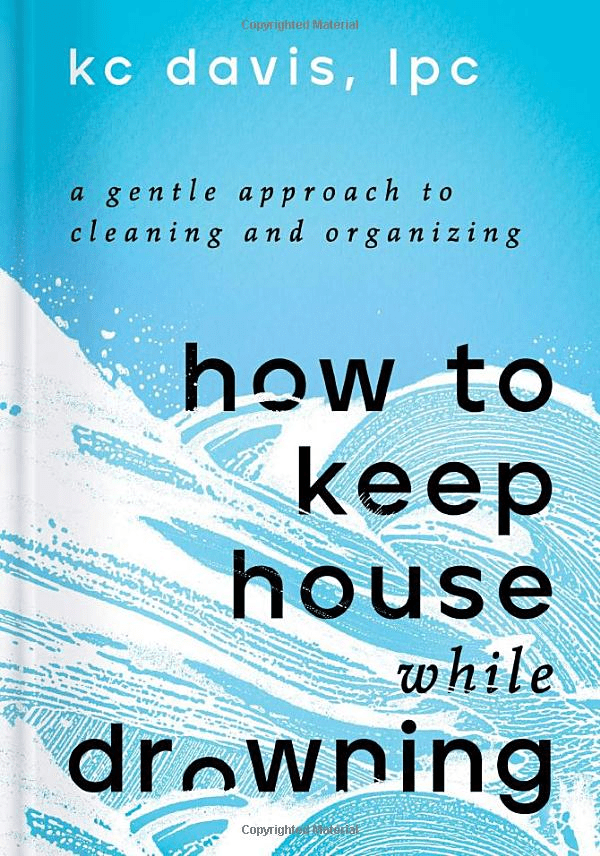
Anyway, the book: “How to Keep House While Drowning”. Written by K.C. Davis, LPC, the book at its most basic level, provides a blueprint for how to take care of yourself and any other living creatures that may depend on you and keep the space you occupy functional. However, I think the book’s true power and meaning (at least for me) is in its subtitle: “A gentle approach to cleaning and organizing.” “Gentle” is the keyword here that’s doing a lot of heavy lifting. Because this book shows you how to do all the cleaning and organizing things even when you are having a hard time, or are someone who tends to struggle more with keeping things clean and organized.
Davis calls cleaning and organizing tasks “care tasks” which I like quite a bit. It’s not “chores” or even, perhaps slightly more specifically “cleaning”. It’s not even the oft-maligned millennialism “adulting”. Care tasks are simply tasks that help to ensure further care for you.
Early on in the book, Davis establishes an important ethos: that care tasks are not moral. That cleanliness or tidiness (which she, I think importantly, notes are different things) is not inherently good or bad and people are not inherently good or bad if they cannot maintain certain standards of aesthetically pleasing cleanliness. In fact, she eschews the goal of aiming for perpetual tidiness or cleanliness altogether.
She also makes it a point to note that caring for a space is important, not because it is moral or aesthetically pleasing, and not even to protect the investment of a rental deposit or home ownership. But because you occupy the space and you deserve to live in a space that is functional for you. And that if an aesthetically pleasing space is not functional or achievable, that’s okay!
For me, cleaning, or care tasks, have always been a struggle. In part because of my obvious inherent lack of skill at it. But Davis points out with gentle compassion that it’s easy to have hangups about cleaning that have nothing to do with skill or laziness and that beating yourself up over it isn’t going to make the space any cleaner or you any happier. She also importantly notes that if you or your space are receiving minimal or lackluster care because you are having a hard time, you need more compassion from yourself, not more self-shame.
While I think this is all extremely helpful for care tasks and mental health, I also think a lot of the book’s takeaways can be extrapolated out further. Don’t get me wrong, I think the book would be valuable just because learning ways to make a space functional for you and ways to be kind to yourself is valuable. But why it hit me so hard was seeing ways it could be applied to other areas of life where I also struggle.
Struggling to get in a groove at work? Find something you enjoy doing or can do quickly and do that first. Davis says momentum builds momentum and you will be more likely to dive into other tasks you dislike or have been putting off if you have momentum. Having a hard time getting started on a project? Another trick she mentions is to set a timer and try to work on it for just five minutes. Five minutes maybe isn’t a lot, but it’s a huge achievement if before you couldn’t do any minutes and were beating yourself up for it. It might also be another way you can build momentum.
Easily digestible main takeaways like “you cannot shame yourself into productivity” and “the best way to do something is the way it gets done” have pretty broad-reaching implications for other areas of life as far as I’m concerned. Ever since 2020, the conventional “wisdom” about working remotely has been that you MUST have a separate office or work space carved away from the rest of your living space. While I understand the advice is an attempt to help people establish and maintain healthy boundaries around work, there’s the obvious point that not everyone has a home office or even a spare closet they can convert. On a personal level, I am lucky enough to have a home office, but some days I really just can’t concentrate in my office. For one thing, I’ve noticed my chair starts to hurt my hips after a few hours (really starting to feel that “elder” in the term “elder millenial”. For another thing, sometimes I just need to physically get up and move to a different chair or room entirely in order to get my brain unstuck. I’ve resolved to stop feeling bad about this. The best way to do a thing is the way it gets done, after all.
Importantly, Davis is careful to talk about rest in this book about finding ways to clean and care for yourself and your space. While it has great takeaways for productivity, she’s careful to point out that no one can be productive at all times and be healthy, no matter what any wealth or career influencer tells you. Humans need rest, and not just the kind where you sleep (which a lot of us also probably don’t get enough of). Some days, it’s great to be able to do care tasks as a kindness to your future self. Other days, you’re going to be more tired and might just need to let the dishes sit in the sink. Both are equally valid choices to make.
Ultimately, for me, this book boils down to learning to prioritize, but not in the way our hustle-and-grind culture would have you believe. It’s not about prioritizing career goals or attainment. It’s not about prioritizing making your living space or your body look a certain way. It’s about prioritizing yourself, through compassionately finding systems that work for you, however imperfect because no one can be perfect all the time, and care that happens imperfectly is better than no care at all.
I can’t guarantee that my house is going to be cleaner because of this book. And I can’t guarantee that I’m going to be more well-rested because of this book. But I am trying to be nicer to myself about both things because of this book. And that is quite a gift.
You can find Davis’s book at your local library, or order it on her website or wherever you find books.
 Laura Bird